


For more than 100 years, the Miami Conservancy District's flood protection system has protected communities across Southwest Ohio from devastating flooding. Maintaining that system requires ongoing investment in five dams, 55 miles of levees and floodwalls, flood storage areas, channels and other critical infrastructure.
MCD is completing the Seventh Readjustment of the Appraisal of Benefits, a process required under Ohio law to determine the flood protection benefits provided by the system and how those benefits are distributed across the region.
The updated approach is designed to provide a fairer, more consistent and sustainable way to fund flood protection for the future.
MCD's flood protection infrastructure is more than 100 years old and requires continued maintenance, rehabilitation and investment.
Over the next 20 years, MCD estimates approximately $450 million will be needed to maintain and rehabilitate the flood protection system. The current funding model is projected to generate approximately half of that amount.
At the same time, the existing assessment methodology is based in part on property values and does not fully reflect the many ways properties and communities benefit from the regional flood protection system.
The Seventh Readjustment addresses both challenges: identifying the benefits the system provides today and creating a more sustainable way to share the cost of maintaining it.
Future flood protection assessments are proposed to no longer be based on property value.
The updated methodology considers two measurable factors:
This approach recognizes that flood protection provides more than protection for properties located next to a river. Roads, hospitals, emergency services, utilities, businesses, jobs and other services throughout the region depend on the system. The changes are overseen by a Board of Appraisers and the COnservancy Court.
MCD's flood protection system provides different types and levels of benefits across the region.
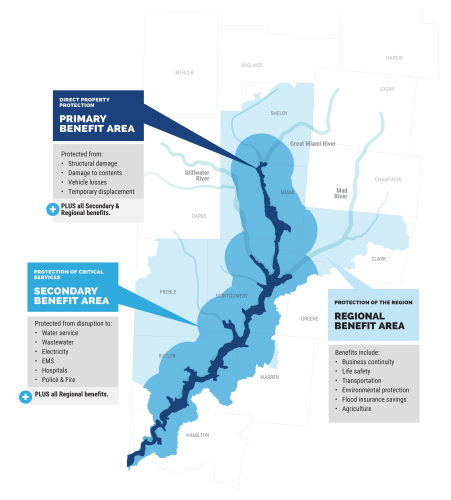
Some properties receive direct protection from flooding. Others benefit because the system helps keep critical services such as roads, hospitals, utilities and emergency services operating. The entire region also benefits from reduced disruption to transportation, businesses, public safety and the economy.
An extensive economic analysis estimates that MCD's flood protection system will provide approximately $7.74 billion in benefits over the next 50 years (net present value, 2024 dollars).
Properties in the Primary Benefit Area receive direct protection from physical flood damage.They also receive Secondary and Regional benefits listed below.
Benefits include avoided damage to:
The estimated value of these direct benefits is approximately $3.79 billion over 50 years.
Properties in the Secondary Benefit Area receive the benefits from the protection of critical services, plus the regional benefits listed below.
These include:
The estimated value of these benefits is approximately $1.92 billion over 50 years.
Flood protection also provides broader benefits throughout the region, including:
The estimated value of these regional benefits is approximately $2.04 billion over 50 years.
The Miami Conservancy District Board of Appraisers uses Equivalent Benefit Units, or EBUs, as a consistent way to distribute flood protection benefits among different types and sizes of properties. Using EBUs provides a common standard that can be applied consistently to residential, commercial, industrial, agricultural and public properties.
There are two separate steps:
1. Determine the benefit.
A property's flood protection benefit is based on its Benefit Area and its number of EBUs.
2. Calculate the assessment.
Once benefits are established, MCD annually sets assessment rates based on the funding needed to operate, maintain and make necessary capital improvements to the flood protection system.
A property's benefit and its annual assessment are not the same thing. The benefit establishes the property's share of the benefits provided by the system. The annual assessment is the amount collected to fund the system.
The flood protection assessments being collected today continue to use MCD's existing appraisal methodology. The Seventh Readjustment of the Appraisal of Beneftis does not change an assessment currently appearing on your property tax bill.
Learn about current flood protection assessments →
The Seventh Readjustment of the Appraisal of Benefits was ordered by the Conservancy Court in 2020. Subject to approval by the Conservancy Court, the new method establishes a new appraisal of flood protection benefits that will be used to determine future assessments.
The updated methodology will not use property values to determine flood protection benefits.
Frequently Asked Questions
Current Assessments & Benefits

Learn more about operations and maintenance activities | Learn more about capital improvement projects

